

Let’s be honest—the insurance pre-authorization process can feel like a maze designed to be confusing. So, what exactly is it?
Think of it as a formal permission slip from your insurance company. Before you can receive certain treatments, like advanced wound care, your provider has to get the insurer’s official approval. This step confirms that your insurance plan agrees the treatment is medically necessary.
Skip this checkpoint, and you could be stuck with an unexpected—and often massive—medical bill. It’s a critical step that you can’t afford to miss.
Why Is Pre-Authorization So Complicated?
At its core, pre-authorization is a cost-control system for insurers. It’s their way of managing spending. Before they agree to pay for potentially expensive services, they want to double-check that the care isn’t just helpful, but absolutely essential according to their own specific rulebook.

For patients and providers, though, this system often feels like a giant roadblock standing in the way of timely care. In a field like wound care, where every day counts, a delay of a few days or weeks can have serious consequences. It can slow down healing and open the door to dangerous complications.
The Key Players And Their Roles
To get through this process, you need to know who’s on the field and what their job is. It’s not just a conversation between you and your insurer; it’s a team effort with several moving parts. A breakdown in communication anywhere along the line can bring everything to a grinding halt.
Here’s a look at who does what so you can better understand the moving parts.
Key Players in the Pre Authorization Game
| Player | Primary Role | Key Responsibilities |
|---|---|---|
| The Patient (You) | The Advocate | Provide accurate insurance info. Follow up consistently. Make sure the request keeps moving forward. |
| The Provider’s Office | The Ally | Gather all necessary clinical documentation (notes, photos, test results). Submit the formal request to the insurer. |
| The Insurance Company | The Gatekeeper | Review the submitted documents against their internal clinical policies. Approve or deny the request. |
As you can see, this collaboration is essential. But it’s also where things can get tangled. One missing document from your doctor or an administrative error at the insurance company can stop the entire process cold.
The real challenge? There’s no standard playbook. Every insurance company makes up its own rules. This creates a deeply frustrating and inconsistent experience for both patients and the people trying to care for them. What one insurer approves without a second glance, another might deny outright.
Why Is It So Inconsistent?
A huge source of frustration comes from this complete lack of uniformity. One insurer might demand a pre-authorization for a specific type of advanced wound dressing, while another doesn’t.
This forces healthcare providers to navigate a constantly shifting patchwork of requirements that changes with every single patient. It’s an administrative nightmare.
This inconsistency isn’t just annoying; it directly hurts patient care. Research has shown that pre-authorization policies among private U.S. insurers vary wildly, with no real agreement on which services actually need approval. This leads to major inefficiencies and creates unequal access to care.
For a deeper dive into these issues, you can explore the disparities in PA requirements on bmj.com. And for more answers to common healthcare questions, feel free to browse our https://windycitywoundcare.com/knowledge-base/.
Building a Bulletproof Authorization Request
Getting an insurance pre-authorization approved isn’t about luck; it’s about meticulous preparation. A quick approval hinges on assembling a comprehensive, undeniable case for why the prescribed wound care is absolutely essential. This isn’t just a matter of providing an insurance ID and group number—it’s about building an airtight clinical argument.
Think of it as telling a story to the insurance reviewer. Your goal is to leave zero room for questions or doubt. Every single document needs to support the central theme: this specific treatment is medically necessary for this specific patient at this specific time.
Gathering Your Core Clinical Evidence
The foundation of any strong request is the clinical documentation from your provider. The insurance company’s reviewer has never met the patient, so they need to see clear, objective proof that justifies the need for care. Missing even one piece of this puzzle can trigger an immediate request for more information, adding frustrating delays to the process.
While the provider’s office is responsible for compiling this package, it’s helpful to know what should be in it. The essentials include:
- The Official Order or Prescription: This is the starting point—the formal request from the doctor for the service.
- Detailed Clinical Notes: These notes should paint a vivid picture of the patient’s condition, including symptoms, wound measurements, tissue type, and the doctor’s complete assessment.
- Supporting Diagnostic Results: This covers any relevant lab work, imaging reports (like X-rays or MRIs), or culture swabs that confirm the diagnosis and rule out other issues.
- A History of Failed Treatments: Insurers almost always want to see that less expensive or more conservative options were tried first. This means documenting previous dressings, medications, or therapies that didn’t resolve the wound.
Key Takeaway: A complete packet is a convincing packet. The more thorough the documentation, the less likely an insurer is to question the medical necessity. It’s all about preemptively answering the questions a reviewer is trained to ask.
The Power of a Letter of Medical Necessity
Beyond the standard forms and lab results, a well-crafted Letter of Medical Necessity (LMN) is your most powerful tool. This letter, written by the provider, is a formal argument that connects all the dots for the insurance reviewer. It transforms a stack of documents into a compelling narrative for approval.
A persuasive LMN goes far beyond simply stating a diagnosis. It must explicitly detail why the requested treatment—for instance, specialized at-home services like the kind of wound care in Chicago Windy City Wound Care delivers—is the best and most appropriate option.
Crucially, the letter should also explain the potential negative consequences of not receiving the treatment, such as hospitalization, limb loss, or a worsening infection. It frames the decision in terms of clinical outcomes, not just cost.
For providers, the language used here is critical. The letter must speak directly to the insurer’s own clinical guidelines, using evidence-based reasoning to demonstrate that the care isn’t just beneficial but indispensable. This is your chance to advocate directly for your patient’s health and well-being, significantly improving the odds of a first-pass approval and avoiding the draining appeals process.
Getting Your Request Submitted and Waiting on the Decision
Once you and your provider have gathered all the necessary paperwork, it’s time to actually submit the request and wait for the insurance company’s decision. This part can feel a bit like sending a message in a bottle and hoping for the best, but knowing what happens behind the scenes can make a world of difference. Your provider’s team will be the one to officially send it off, usually through a dedicated online portal, by fax, or sometimes, via a structured phone call.
Each submission method has its own quirks. I’ve seen online portals time out and lose everything, and I’ve seen entire fax submissions get rejected because a single checkbox was missed—with no notification sent back. This is why triple-checking everything before it goes out the door is non-negotiable. A simple mistake, like a typo in a policy number or a missing signature, is one of the most common reasons for an immediate denial. That forces you right back to square one.
Here’s a look at the typical journey a pre-authorization request takes from submission to the final verdict.
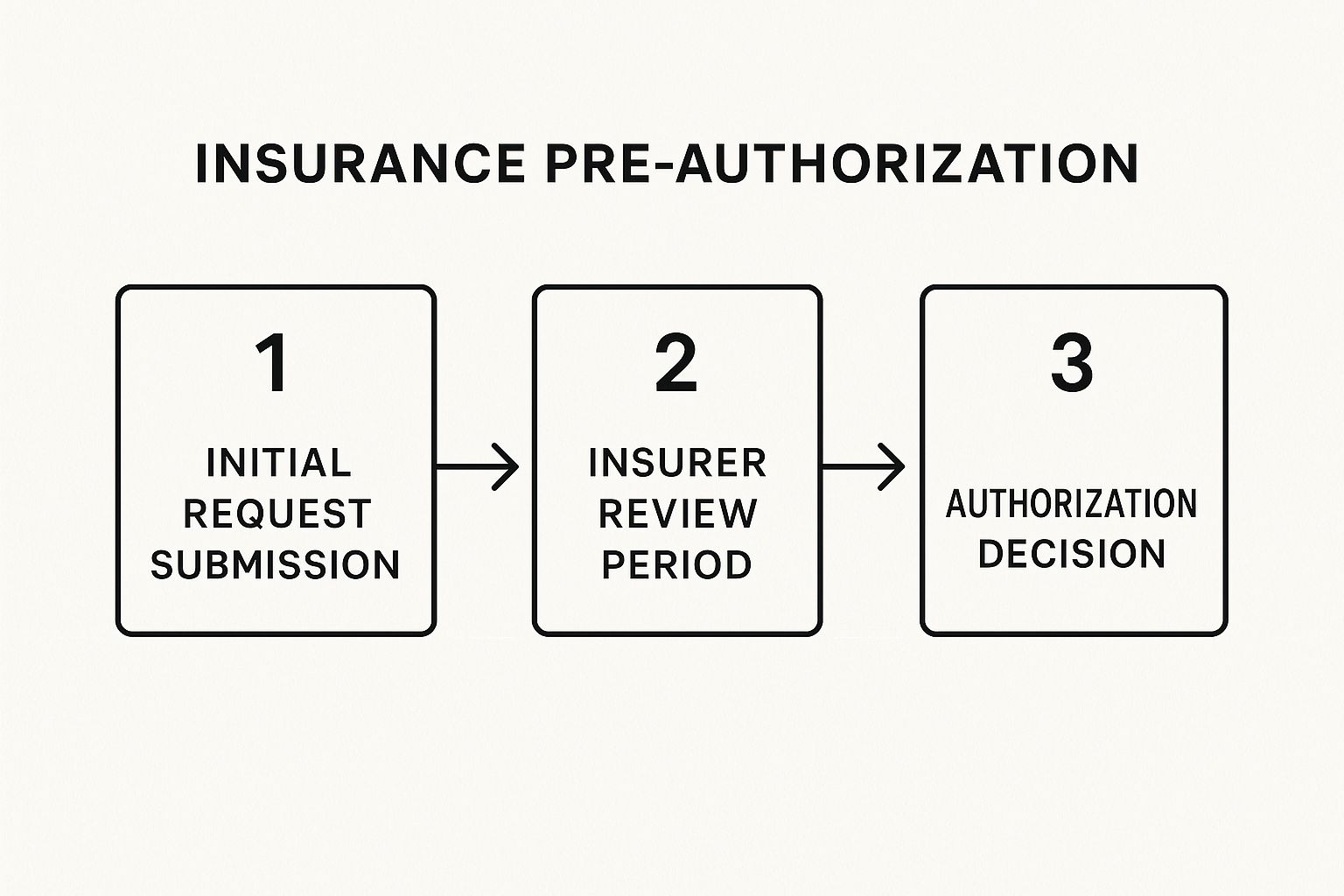
As you can see, the request moves through several distinct stages. Each one is a potential bottleneck where things can get delayed or denied if the submission isn’t handled perfectly.
What Happens During the Insurer’s Review?
After your request is submitted, it enters the insurer’s internal review system—it doesn’t just land in a general inbox. A clinical reviewer, who is usually a nurse or doctor working for the insurance company, is assigned to your case. Their entire job is to take the medical evidence your provider sent and stack it up against a strict set of internal guidelines and policies for the specific treatment you need.
This is where your provider’s detailed, story-telling documentation becomes absolutely critical. The reviewer is hunting for clear, objective proof that the treatment—like specialized at-home wound care services—is truly medically necessary. The sheer volume of these requests is staggering. In 2023, Medicare Advantage plans alone handled nearly 50 million prior authorization requests. Denial rates can vary wildly, too. For instance, Centene denied 13.6% of requests, while Humana only denied 3.5%. It just goes to show how much the outcome can hinge on your specific insurance plan. You can dig into a full breakdown of these numbers on KFF.org.
Pro Tip: Don’t just sit back and wait. As a patient, you have every right to be proactive. Call your provider’s office a day or two after they submit the request to confirm it was sent and that the insurer received it. Then, call your insurance company yourself to verify they have it on file and ask for a reference number. This simple step can keep your request from disappearing into an administrative black hole.
The Three Possible Outcomes: What to Expect Next
The review period can last anywhere from a few days to a couple of weeks. Once it’s complete, both you and your provider will get a formal notice with the decision. You should be ready for one of three possible outcomes, as each one requires a different plan of action.
- Approved: This is the green light you’ve been waiting for! The insurer agrees the treatment is necessary and issues an authorization number. Now you can finally move forward and schedule your care.
- Request for More Information: This is not a “no.” It’s a “not yet.” It just means the reviewer needs more evidence to make their final call. Your provider will have to quickly supply the missing lab results, clinical notes, or other justifications.
- Denied: This is the one everyone dreads, but it is not the final word. A denial notice must include the specific reason for the rejection, and that reason is your roadmap for launching a successful appeal.
No matter the initial result, it helps to understand the factors that directly influence home health wound care patient outcomes. Any delay or denial has a real, tangible impact on the healing process.
How to Fight Back When a Request Is Denied
Getting a denial letter can feel like a punch to the gut. It’s easy to see it as a final, non-negotiable verdict, but from my experience, it’s often just the first move in a negotiation. When a critical wound care service is rejected, that’s your signal to shift from patient to advocate. Your game plan for a successful appeal starts the second you open that denial notice.
Don’t just skim it. You need to dissect the denial letter. Buried in all that formal language is the single most important piece of information you’ll need: the exact reason they said no. Was it a simple clerical error? Did they claim a lack of supporting documents? Or, the most common one, did a reviewer decide the care was “not medically necessary”? That reason is the key that unlocks your entire appeal strategy.

Understanding Your Appeal Options
Once you know why the insurance company denied the request, you can figure out the best way to fight back. You generally have two main avenues for an appeal. Knowing the difference between them is crucial for planning your next steps.
When you’re faced with a denial, it helps to understand the two main stages of appealing that decision. This table breaks down the difference between an internal appeal and an external review so you can choose the right path for your situation.
Internal Appeal vs External Review
Understand the two main stages of appealing a denial to choose the right path for your situation.
| Feature | Internal Appeal | External Review |
|---|---|---|
| Who Reviews It | The insurance company itself, just with a different medical reviewer who wasn’t involved in the first decision. | An independent, third-party organization that has no financial ties to your insurance company. |
| When to Use It | This is always your first step. It’s relatively quick and surprisingly effective for simple denials or missing paperwork. | Use this after your internal appeal is denied or for highly complex medical disputes where an outside expert is needed. |
| What It Costs | Nothing. This is a right included in your health plan. | Usually free for you. The cost is typically covered by the insurance company as required by law. |
Think of the internal appeal as your first, mandatory shot. You’re essentially asking the insurance company, “Are you sure? Can you please take another look?” You’d be surprised how many denials are overturned right here, especially if the rejection was due to something simple like missing information that you can now provide.
Don’t get discouraged by that first “no.” A deep dive into Medicare Advantage plans revealed that over 80% of initial prior authorization denials are overturned when appealed. Your persistence can genuinely pay off.
Strengthening Your Case for the Appeal
To win, you can’t just resubmit the same old paperwork. You have to directly counter the reason they gave for the denial. Your mission is to build a case so strong that the next reviewer—whether they’re internal or external—has no doubt that this care is absolutely essential.
Here are a few proven strategies I’ve seen work time and time again:
- Arm Them with New Evidence: Did the patient just get a new lab test, an imaging scan, or a wound culture back? Any new piece of clinical documentation that reinforces the medical necessity should go into your appeal package.
- Get a Second Opinion: A letter from another physician who backs up the original treatment plan is incredibly powerful. It demonstrates a medical consensus that this isn’t just one doctor’s opinion, but the standard of care.
- Write a Personal Impact Letter: This is where the human element comes in. The patient or a family member should write a letter explaining, in plain terms, how this denial is affecting their life. Describe the pain, the inability to do daily tasks, or how the wound is impacting their overall health and well-being. This personal touch can make a sterile case file feel real.
For certain treatments, highlighting why at-home services are critical can be a game-changer. Explaining why a patient can’t easily get to a clinic, or why the home environment is safer for them, adds another compelling layer to your appeal. You can learn more about why home health care is essential for so many people on their recovery journey.
Fighting an insurance denial takes grit and organization, but with the right strategy, you can absolutely turn that “no” into a “yes.”
Insider Tips for a Smoother Approval Process

While you can’t completely sidestep the insurance pre-authorization process, you can definitely learn to navigate it more effectively. A few smart moves from both patients and providers can cut down on the friction and prevent those frustrating, unnecessary delays.
If you’re a patient, the single most important thing you can do is become your own best advocate. You simply can’t afford to be passive.
Start by reading your insurance policy before you need a procedure, so you already have a handle on your coverage. When it’s time to get an authorization, keep a detailed log of every single phone call with your insurer. Note the date, time, and the name of the representative you spoke with.
Pro Tip for Patients: Always, always ask for a reference number for your pre-authorization request. This number is your golden ticket—it’s proof that the request was made and is the key to tracking its journey through their system.
Advice for Healthcare Providers
In a busy healthcare office, efficiency is everything. One of the best moves you can make is to have a dedicated authorization specialist on your team. This person lives and breathes the nuances of different insurance plans and can get approvals far more quickly than someone who’s juggling a dozen other tasks.
Another game-changer is mastering each insurer’s online portal. These portals are almost always the fastest route to submit a request and get a decision back.
It’s also incredibly helpful to keep a “cheat sheet” that breaks down the specific clinical policies and preferences for your most common payers. This simple tool can help you avoid the common pitfalls that lead to instant denials. For specialized services, understanding what mobile wound care is and why it’s important will equip you to better explain the value of at-home treatment to insurers.
The Future of Pre-Authorization
Thankfully, there’s a glimmer of hope on the horizon for making this whole ordeal less painful. Insurers are finally acknowledging the immense administrative headache and are facing real pressure to modernize. In fact, major insurance trade groups have committed to a significant overhaul of the prior authorization system.
The goal is to process 80% of all electronic requests in real-time by 2027, a shift that would impact around 257 million Americans. We’ve heard similar promises before with limited follow-through, but this new push toward automation and better workflows is being met with some cautious optimism. You can read more about the industry’s commitment to fixing prior authorization on medicaleconomics.com to see what’s coming.
By adopting these insider tips, both patients and providers can better manage the system as it is today while keeping an eye on a potentially more efficient future.
Common Pre-Authorization Questions Answered
https://www.youtube.com/embed/QCckI5rDgRw
Even when you think you have a handle on the insurance pre-authorization process, specific questions almost always seem to pop up. Getting clear, direct answers to these common hurdles can save you a ton of stress and confusion down the road.
We’ve tackled some of the most frequent questions we hear from both patients and providers. Think of this as your quick-reference guide for those moments when you just need a straightforward answer without digging through dense policy documents.
How Long Does This Process Usually Take?
The timeline for getting a decision can vary dramatically. For a standard, non-emergency request, you should generally expect to wait anywhere from 3 to 14 business days.
This window really depends on your specific insurance company, the complexity of the requested service, and whether your provider’s office submitted a complete and accurate packet of information on the first try. Any missing detail can send you right back to the starting line.
But what if your medical situation is genuinely urgent? In these cases, the process can be fast-tracked. Your provider can submit an “urgent” or “expedited” request, which legally requires the insurer to provide a decision much faster—typically within 24 to 72 hours. It’s absolutely crucial that your doctor clearly flags the request as urgent if a delay could jeopardize your health.
A Quick Tip: An approved authorization is only valid for a specific window of time. If you don’t schedule your procedure within that period, the approval will expire. Your provider will have to start the entire insurance pre-authorization process all over again.
Can I Get Treatment Without a Pre-Authorization?
Technically, yes, you can receive a service without a required pre-authorization. But doing so is a massive financial gamble. If you go ahead with a treatment that your plan required approval for, the insurer will almost certainly deny the resulting claim.
That would leave you personally responsible for 100% of the cost. For many services, like advanced wound care or specialized imaging, this could easily amount to thousands of dollars out of your own pocket.
Because of this risk, most hospitals and specialized clinics won’t even schedule your procedure until they have a confirmed authorization number in hand. It’s always the safest and smartest move to wait for that official green light.
What Is the Difference Between Pre-Authorization and Pre-Certification?
For all practical purposes, there is no meaningful difference between these terms. It’s one of those areas where insurance companies love to use different words for the exact same thing. You might see it called:
- Pre-authorization
- Prior authorization
- Pre-certification
- Prior approval
Don’t get bogged down by the terminology. No matter what they call it, the function is identical: it’s a mandatory checkpoint where your provider must get the insurer’s approval before a service is rendered to confirm it meets their definition of medical necessity.